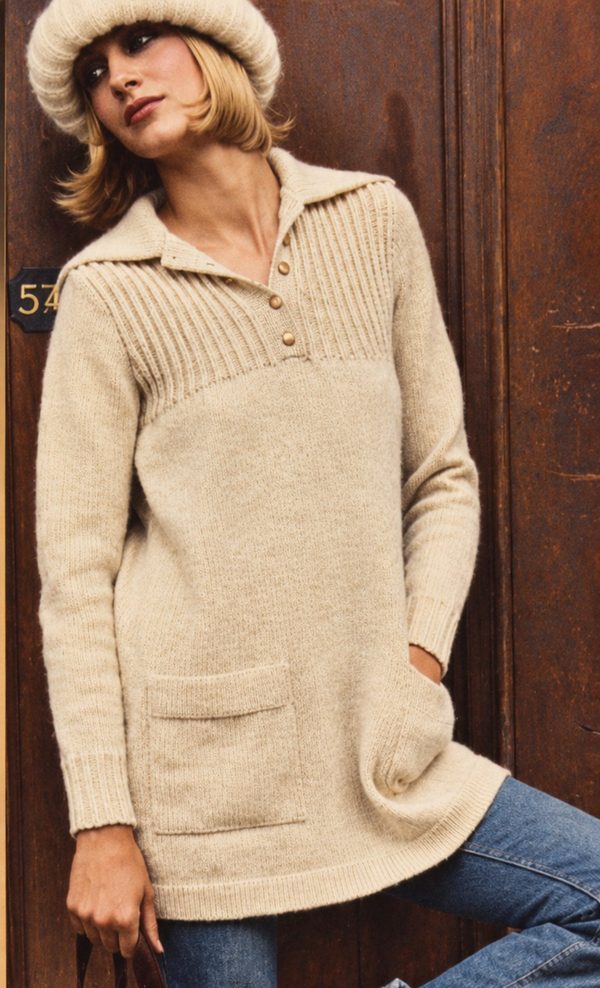
A 1970s design
The Bloomsbury Smock
rewritten for your size, yarn and gauge
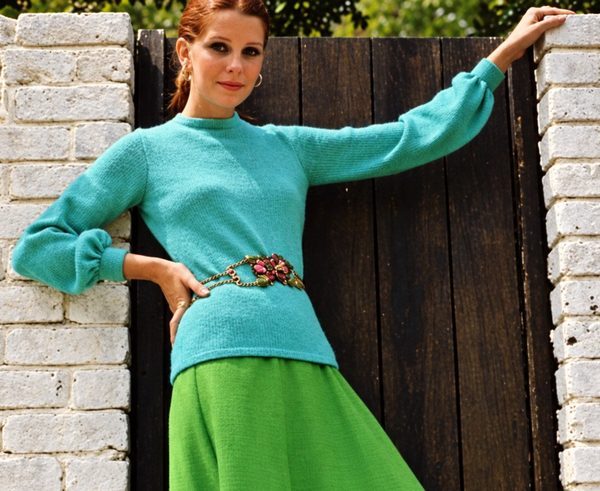
A long, loose 1970s smock to wear with jeans or over a skirt. Plain stockinette below a deep yoke of tiny crossed ribs, a buttoned opening at the front, a big garter-stitch collar, two patch pockets with garter tops, and full sleeves gathered into ribbed cuffs.
- Fit
- Loose tunic, about 11½–13 in (29–34 cm) of ease at the bust; hip length
- Skill level
- Intermediate. A crossed-rib yoke, a buttoned opening, a collar and pockets.
- Sizes
- US 4 to 24 (UK 8 to 28, EU 36 to 56): 32 to 52 in (81 to 132 cm) bust
- Knit it
- Your choice when you make your pattern: flat, in pieces, as the original, or in the round up to the yoke, with no side seams below it.
- Yarns
- Fingering / 4-ply, Sport, DK / light worsted, Worsted / Aran
- Original yarn
- DK (light worsted), at about 22 sts and 30 rows to 4 in (10 cm) over stockinette. For the closest match to the photo, use a yarn that knits to this gauge.
- Gauge
- Your own, from 18 to 30 stitches per 4 in (10 cm)
- You get
- Your complete pattern straight away, to read on screen, print or save, plus an email link back to it
Bulky (chunky) yarn isn't offered: a long tunic with a deep garter collar gets very heavy, and the crossed rib turns coarse.
£5.95Make it in my size
What you'll get
- Every piece written out in full for your size and gauge
- Row counts with the length to check against, so you always know where you are
- Row-by-row planners for the tricky bits, where shaping happens on both edges at once
- Drawings of each piece with your measurements, and full making-up instructions
Every design is chosen by a knitter and checked against its original pattern. If you get stuck, email us and a real person will help.
No swatch? You can use the gauge on your yarn's label. For a perfect fit, knit a swatch and measure it over plain stockinette on your main needles. Here's how to measure your gauge.