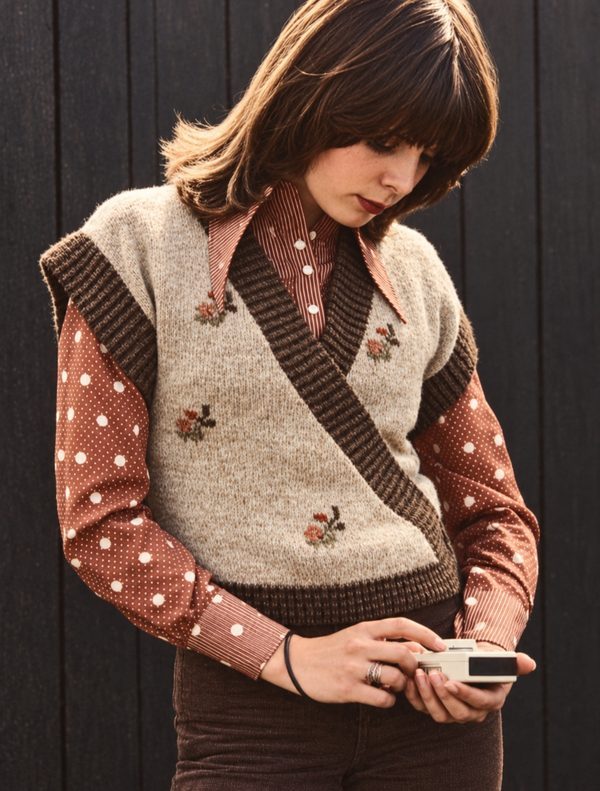
The Portobello Wrap
rewritten for your size, yarn and gauge
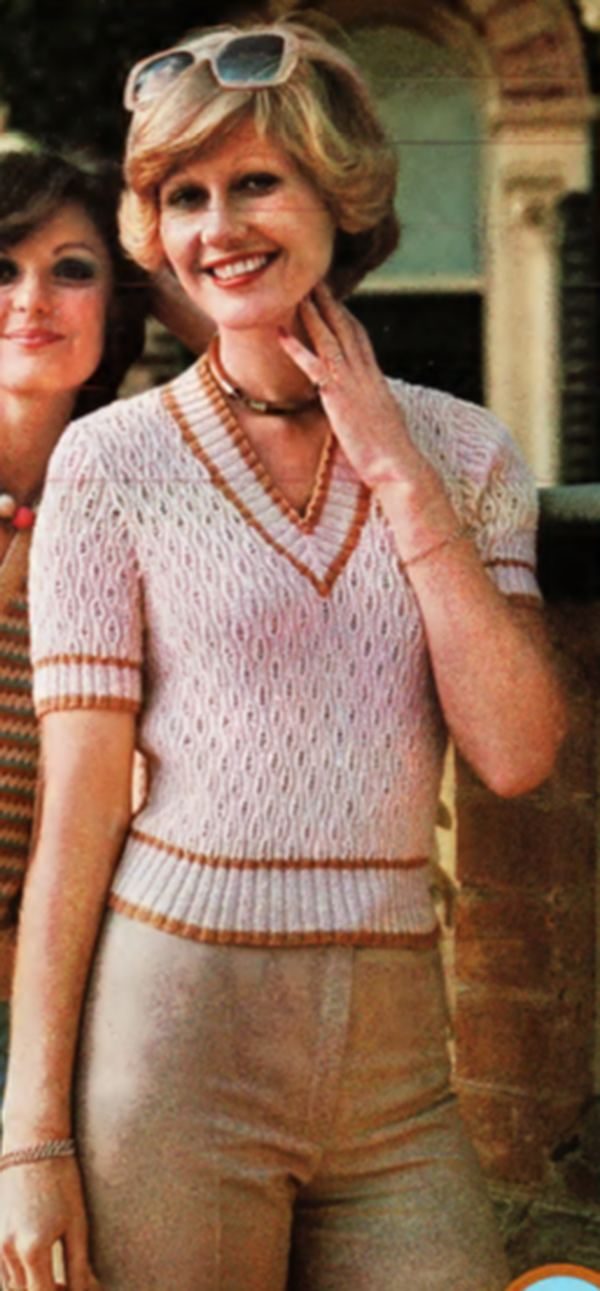
A close-fitting 1970s wrap top. The two fronts cross right over the body from each shoulder to the opposite hip and fasten with press studs hidden on the ribbed welt at the side seams. It has cap sleeves, deep rib bands striped in two contrast colours round every edge, and tiny roses Swiss-darned onto the fronts from a chart. Wear it over a shirt with a big collar.
- Fit
- Close-fitting cross-over wrap, waist length, with cap sleeves
- Skill level
- Intermediate. Crossover fronts, striped bands, and roses added afterwards in duplicate stitch (Swiss darning).
- Sizes
- US 4 to 24 (UK 8 to 28, EU 36 to 56): 32 to 52 in (81 to 132 cm) bust
- Yarns
- Fingering / 4-ply, Sport, DK / light worsted, Worsted / Aran
- Original yarn
- DK (light worsted), at about 24 sts and 32 rows to 4 in (10 cm) over stockinette. For the closest match to the photo, use a yarn that knits to this gauge.
- Gauge
- Your own, from 18 to 30 stitches per 4 in (10 cm)
- You get
- Your complete pattern straight away, to read on screen, print or save, plus an email link back to it
Bulky (chunky) yarn isn't offered: where the fronts cross there are two layers plus the striped bands, and a close wrap gets too bulky.
What you'll get
- Every piece written out in full for your size and gauge
- Row counts with the length to check against, so you always know where you are
- Row-by-row planners for the tricky bits, where shaping happens on both edges at once
- Drawings of each piece with your measurements, and full making-up instructions
Every design is chosen by a knitter and checked against its original pattern. If you get stuck, email us and a real person will help.
No swatch? You can use the gauge on your yarn's label. For a perfect fit, knit a swatch and measure it over plain stockinette on your main needles. Here's how to measure your gauge.